AI & Automation Implementation

Put AI to work in your daily operations.

  • Practical automation.
  • Connected systems.
  • Human accountability.

We help businesses put AI and automation to work inside real operations, connecting existing systems and improving the workflows your team depends on.

01 / From tool to workflow

The work begins where the demo ends.

A subscription can give your team access to a tool. A demonstration can show what it does with one example. Daily operations ask more of it.

Consider a team copying details from incoming documents into a business system. Extracting fields is one step. The workflow also needs a source for checking those fields, a way to catch duplicates, and a person who can resolve ambiguous cases.

We design around how the work gets done: where it starts, which rules it must follow, who can approve a result, and what evidence tells the team it is ready to use. That gives people a way to adopt the capability inside the systems and responsibilities they already understand.

02 / Illustrative applications

Where the work gets stuck.

These examples show how an implementation might address recurring operational friction. We scope each workflow around its own data, people, and constraints.

Documents and information
When staff retype details from forms or PDFs, extract candidate fields and send incomplete or conflicting records for review before entry.
Customer service
When agents spend time searching for policy details, surface relevant approved material and draft a reply the agent can check before sending.
Sales and administration
When incoming requests get buried in a shared inbox, route them by known rules and flag incomplete requests for follow-up.
Internal knowledge
When answers are scattered across manuals and notes, retrieve relevant passages from approved sources with links back to the original material.
Operational reporting
When someone reconciles exports by hand, assemble reports from agreed sources and expose discrepancies for the people responsible for resolving them.
System integration
When teams enter the same update in multiple tools, synchronize agreed fields through their APIs and flag failed updates for follow-up.

03 / Technology selection

Choose the method the decision requires.

Business rules, uncertainty, and the consequences of an error determine how far automation should go.

Deterministic automation
When the business can state an exact rule, implement it directly. A known approval limit or record-matching condition should yield the same result from the same inputs.
AI-assisted workflows
Use a model when the task involves variable text or documents, such as extracting candidate details from inconsistent forms. Test where its suggestions hold up before depending on them.
Human-reviewed decision support
Where context is incomplete or the decision carries consequences, surface supporting information and keep approval with the person who owns it.
Combined approaches
Use a model to suggest a value, business rules to check it, and a review queue to handle the cases neither can resolve on its own.

04 / Implementation scope

What has to work behind the scenes.

Workflow discovery
Follow representative cases from intake to completion and document decisions, exceptions, and where responsibility changes hands.
Integration architecture
Decide which system owns each record, what information moves between tools, and how failed updates can be recovered.
Data and permissions
Agree which data the workflow can read or write, who can review it, and which access boundaries it must preserve.
Implementation and orchestration
Connect the approved systems and implement the sequence of rules, model calls where appropriate, and handoffs the workflow requires.
Reviews and exceptions
Define what gets queued, what reviewers see, and how corrected or missing inputs are handled.
Testing and evaluation
Use representative routine and difficult examples to verify business behavior, including when the workflow should stop and ask for review.
Deployment and handover
Release into the agreed environment and document how to monitor failures, review output, and make changes after launch.

05 / Working together

Prove the workflow with the people who run it.

You bring a process owner, representative examples, and approved access. We bring the engineering and make implementation decisions visible.

  1. Trace the current work

    Walk through real examples with the people who process them. Agree what should improve and how you’ll evaluate it.

  2. Agree the design and boundaries

    Confirm source systems, access, permitted actions, review points, and the scenarios that define acceptance.

  3. Build and review representative cases

    Connect the workflow and review outputs with domain experts. Work through disagreements and edge cases before release.

  4. Release and establish ownership

    Deploy with agreed responsibilities for approvals, exceptions, and failures, and give the operating team the documentation to carry them out.

06 / Workflow engineering in practice

Business rules and responsibilities made explicit.

Workforce operations / Systems integration

Limpieza Inteligente

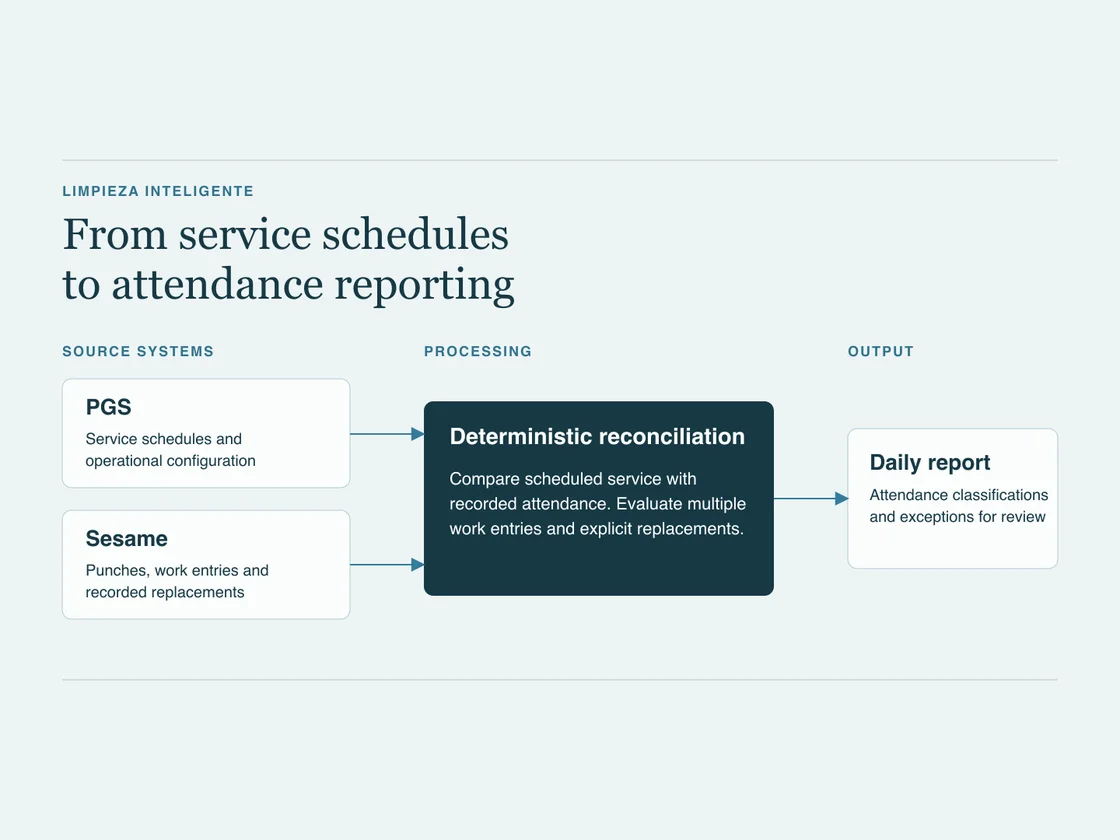
Attendance reporting had to reconcile expected services with actual records and employee replacements.

Juvasoft connected operational schedules to attendance evidence using explicit rules. Multiple work entries and exceptions could be handled while preserving each system’s responsibility.

That engineering is directly relevant when an automation must explain how it reached a result and flag cases that need attention.

PGS schedules and Sesame attendance evidence feed deterministic reconciliation and a daily exception report.
Read the Limpieza Inteligente case study

Supply management / Workflow modernization

Insumos

Distributed locations needed a shared way to organize supply requests.

Juvasoft worked on a centralized request workflow where staff could see requests across locations and access was shaped by their responsibilities.

Before automating a handoff, it helps to establish who owns it and what information the next person needs. Those decisions are part of the software design.

Read the Insumos case study

How we engineer with AI

Our articles on AI-assisted development accountability and agentic development in production explain how our engineers review, verify, and own the changes they make.

07 / Choosing a starting point

Start at the scale of the problem.

One defined workflow. Start with implementation when you know the task, who owns it, and which systems and people take part.

Several possible opportunities. An AI Opportunity Assessment helps you choose where discovery and investment are justified.

A wider operational change. If multiple systems or teams need to change together, End-to-End Product Engineering can take on the broader initiative.

Which workflow would you change first?

Bring a repetitive task, a bottleneck, or two systems that should work together. Tell us where the work slows down and what a better outcome would look like. We can work out the technology from there.

Discuss your workflow